In the world of property management,
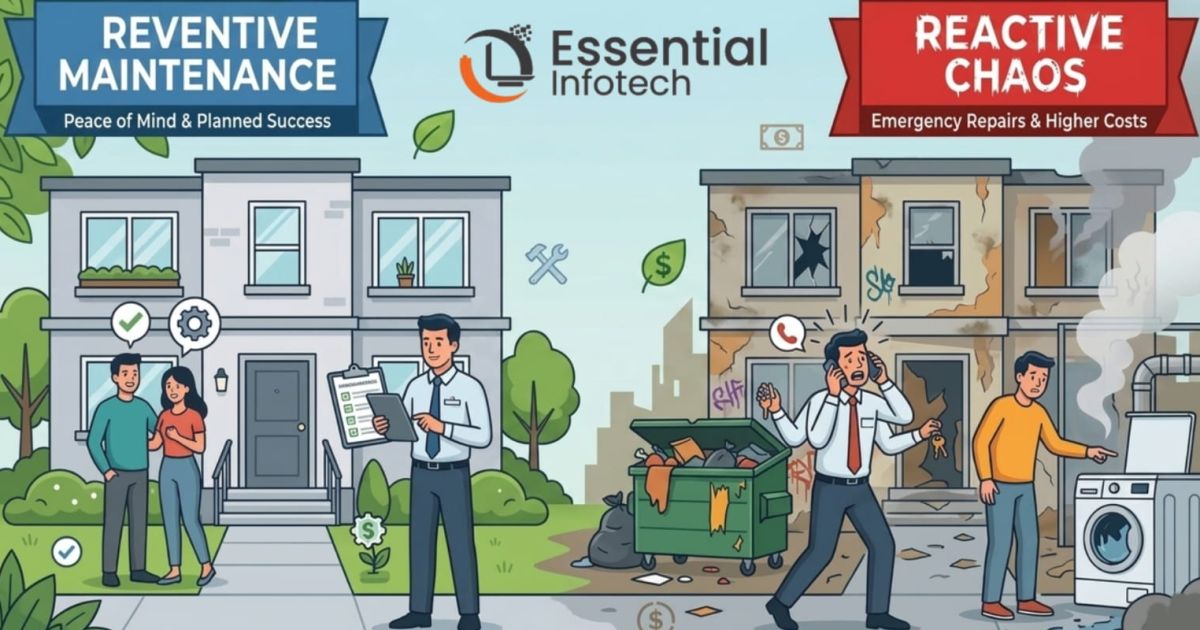
there’s a sound that every manager dreads: the 2:00 AM phone call. Usually,
it’s a tenant reporting a "small leak" that has already turned the
kitchen into a makeshift swimming pool.
Historically, we’ve called this
"business as usual." In 2026, we call it a failure of management.
The 2026 State of Property
Management report recently dropped a truth bomb: 56% of property owners
now prioritize maintenance support above all else. Owners aren't just
looking for someone to collect rent; they’re looking for someone to protect
their asset from the "Reactive Chaos" that eats ROI for breakfast.
1.
The Death of the Emergency Repair
The "Break-Fix" model is
dying, and IoT (Internet of Things) is the executioner. We are entering the era
of the Smart Building, where the walls literally talk to you.
Instead of waiting for a tenant to
notice a drop in water pressure, tiny acoustic sensors detect microscopic vibrations
caused by pinhole leaks. Smart HVAC sensors monitor "vibration
signatures"—when a bearing starts to wear out, the system flags it weeks
before the unit actually seizes.
The ROI is undeniable:
Case Study: The 2025 Multi-Family
Transformation > A mid-sized property firm in
2025 implemented AI-driven leak detection across 500 units. Within six months,
they caught 12 "silent leaks" behind drywall that would have caused
an estimated $140,000 in water damage and mold remediation. Their emergency
plumbing calls dropped by 40%.
Read more on how AI reduces downtime in modern
facilities.
2.
Meet the "Digital Twin": Your Property’s Virtual Stunt Double
Troubleshooting used to involve
sending a tech to poke around in a dark basement for three hours. Now, we have Digital
Twins.
A Digital Twin is a virtual 3D
replica of your building fed by real-time IoT data. If an HVAC unit on the 4th
floor is underperforming, you don't send a van; you open the Twin. You can
simulate the impact of deferring a repair or changing an air-handler speed
without touching the actual equipment.
Digital Twins are turning the tide
by:
Read more on how Digital Twins are revolutionizing
real estate.
3.
From "Fixer" to "Provider": The Subscription Revenue Model
Perhaps the most human shift in 2026
is how we bill for this. Smart managers are moving away from "maintenance
markups"—which feel like a penalty to owners—and moving toward Subscription-Based
Maintenance.
Imagine a tiered membership plan for
your tenants and owners:
This
"Maintenance-as-a-Service" (MaaS) creates predictable, recurring
revenue and keeps your residents in their units longer. When everything
just works, people don't move.
Read more on the rise of subscription living models.
How
Essential Infotech BPO Powers Your Growth
Transitioning from a traditional
"firefighting" office to a tech-enabled powerhouse is a heavy lift.
Most property management companies are buried in the noise of daily operations.
Essential Infotech BPO acts as your engine room.
While you focus on owner
relationships and portfolio growth, Essential Infotech handles the
technical and administrative backbone:
The
Bottom Line
In 2026, the best property manager
isn't the one with the biggest wrench; it’s the one with the best data. By
moving from Reactive Chaos to Preventive Maintenance, you aren’t
just saving money—you’re buying back your time.
Ready to stop the 2:00 AM phone
calls?
·
What is the difference between preventive maintenance
and reactive maintenance in property management?
·
How do IoT sensors help predict maintenance
issues before they become emergencies?
·
What are digital twins and how do they improve
property maintenance troubleshooting?
·
How much money can predictive maintenance save
property management companies?
·
What types of IoT devices are most effective for
building maintenance monitoring?
·
How do subscription-based maintenance services
work for property managers?
·
What data should property managers track to
implement predictive maintenance?
·
How long does it take to see ROI from
implementing IoT-based maintenance systems?
·
What are the biggest challenges when
transitioning from reactive to predictive maintenance?
·
Which property types benefit most from
IoT-enabled maintenance systems?
·
How do you justify the upfront costs of smart
building technology to property owners?
·
What maintenance tasks can be completely
automated with IoT systems?
·
How do predictive maintenance systems handle
seasonal maintenance needs?
·
What happens when IoT sensors fail or provide
false readings?
·
How do you train maintenance staff to use
predictive analytics tools?











We Are A Leading IT Company Experienced In Creative And Innovative Development And Design Solutions .

We are a leading IT company experienced in innovative development and design solutions. We have a unique, out-of-the-box approach to cope with custom clients' needs and demands. Success is essential to your business; so are we!
© 2023 All Rights Reserved by Essential-Infotech