We’ve all been there. It’s 11:00 PM
on a Tuesday, and you’re staring at a screen in your home office,
double-checking an entry for an e-commerce order or re-reading a property
listing for the fourth time. You hired an outsourced team to save time,
yet here you are—the bottleneck.
If you feel like your business would
collapse the moment you stop hovering, you don't have a staffing problem. You
have a documentation problem.
For founders in high-velocity US
sectors like Real Estate, IT, and E-commerce, the "Exit Strategy"
isn't about selling the company yet; it’s about exiting the day-to-day
weeds. Here is how to transition from Chief Micromanager to Chief Visionary
by building an "SOP-first" engine.
1.
The Psychology of the "Hover": Why We Micromanage
Micromanagement usually stems from a
place of excellence—you care about your brand. But in 2026, "doing it all
yourself" is no longer a badge of honor; it’s a scaling liability. Leading
experts at Harvard Business Review note that the inability to delegate
is the primary killer of startup momentum in competitive markets.
The fix isn't "trusting
more"; it's establishing a culture where the process is the boss.
By creating "Human-in-the-Loop" systems, you allow your team to
handle the volume while you handle the vision.
2.
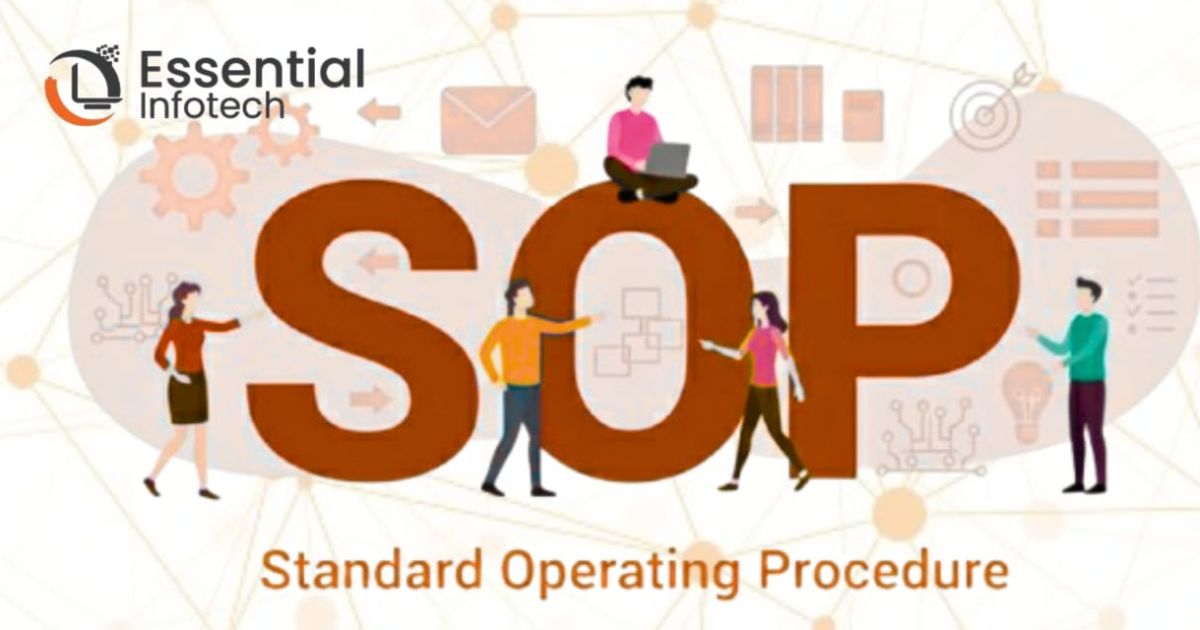
The "SOP-First" Framework: Moving from Mind to Manual
To stop micromanaging, you must turn
your brain into a searchable database. Don't just write a list of tasks; create
a Decision Tree. For a deep dive into why systems outperform talent
alone, check out the E-Myth methodology on business systematization.
3.
Industry-Specific "Exit" Blueprints
4.
Leveraging the "Human+AI" Synergy
In 2026, SOPs aren't just dusty
PDFs. They are living assets. Leading BPO providers like Essential Infotech BPO help
US businesses integrate Robotic Process Automation (RPA) and AI into
their workflows. We don't just take over your tasks; we help you refine the
process. Whether it’s automating data entry for a US-based real estate CRM or
using AI to categorize IT support tickets, our goal is to build a system where
the "Human-in-the-loop" is there for strategy, not just keystrokes.
[Template]
SOP-01: The Order Fulfillment & Exception Logic
Objective: To ensure 100% accuracy in order processing while handling
"edge cases" without needing to message the Founder.
1.
Metadata
2.
The "Start" Trigger
3.
The Decision Tree (The "Micromanagement Killer")
|
If This Happens... |
Then Do This... |
|
Item is Out of Stock |
Email customer with a 15% discount code + restock date. Do
NOT wait for Founder approval. |
|
Address is Invalid |
Use Google Maps to verify. If still unclear, put order on
"Hold" and email customer immediately. |
|
Order > $500 |
Add "Signature Required" and notify the Founder
via the #HighValue Slack channel. |
The
Final Verdict: Your Time is the ROI
Every hour you spend building a
robust SOP is an hour you buy back for the rest of your life. By delegating the
"how" to a trusted partner like Essential Infotech BPO, you
finally gain the freedom to focus on the "why."
Why
this works for your BPO Partner
When you hand a document like this
to Essential Infotech
BPO, you aren't just giving us a task; you are giving us autonomy.
Our team takes these templates and integrates them into a high-performance
workflow, often identifying ways to further automate the
"Step-by-Step" portions so we can spend more time on the
"Decision Tree" logic.
Ready to stop hovering and start
growing?
Schedule a Strategy Call with Essential Infotech BPO
today and let's build your exit strategy from the daily grind.
·
What are the most effective exit strategies for
micromanagers transitioning to remote teams?
·
How do you create SOPs that actually work for
outsourced teams without constant supervision?
·
What documentation formats work best for virtual
assistants and offshore employees?
·
How long does it typically take to build
comprehensive SOP-first documentation?
·
What are the biggest mistakes micromanagers make
when delegating to outsourced teams?
·
How do you maintain quality control without
micromanaging remote workers?
·
What tools are essential for creating and
managing SOP documentation?
·
How do you train outsourced teams to follow SOPs
consistently?
·
What metrics should you track to measure
successful delegation to remote teams?
·
How do you handle cultural differences when
working with international outsourced teams?
·
What's the difference between process
documentation and SOP documentation?
·
How often should SOPs be updated and revised for
outsourced teams?
·
What industries benefit most from SOP-first
documentation strategies?
·
How do you create accountability systems for
remote teams without micromanaging?
·
What are the legal considerations when sharing
SOPs with outsourced providers?











We Are A Leading IT Company Experienced In Creative And Innovative Development And Design Solutions .

We are a leading IT company experienced in innovative development and design solutions. We have a unique, out-of-the-box approach to cope with custom clients' needs and demands. Success is essential to your business; so are we!
© 2023 All Rights Reserved by Essential-Infotech